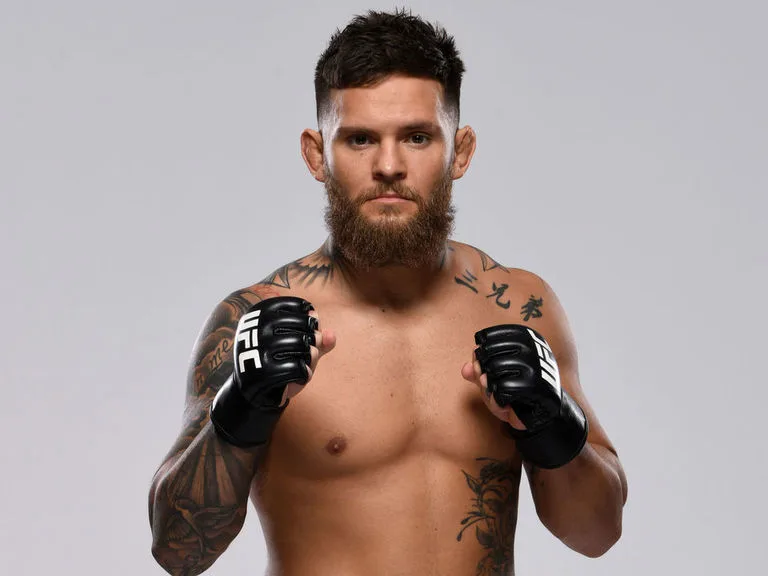
Vince Murdock in fighting stance as a professional MMA fighter before his moyamoya diagnosis
VINCE'S STORY

EVERY MILE IS A FIGHT. from the cage to the road.

A professional MMA fighter preparing for the UFC discovers his brain is dying. A quarter of his skull is removed during emergency surgery. Then he gets on a bicycle and rides 10,000 miles back to life.

12-6-0 MMA record
$36K+ Raised for research
10,000+ Miles ridden

Authored by Vince Murdock, moyamoya survivor. Last updated: 25 May 2026.

BY THE NUMBERS

A LIFE MEASURED IN ROUNDS AND MILES.

12-6-0 Pro MMA record
100% Left carotid blocked
10,000+ Rehab miles, 8 months
11 Months to fight return
2009 – 2019

THE FIGHTER.

Three months before his diagnosis, Vince was preparing to fight in the UFC.

Vince Murdock grew up in Lapeer, Michigan. His father was incarcerated. There was no safety net waiting for him, no steady hand guiding him through childhood. What he had was a jaw that would not break and a refusal to stay down. He funnelled every ounce of that into fighting.

He left Michigan for Sacramento and walked through the doors of Team Alpha Male, the gym built by UFC Hall of Famer Urijah Faber. He trained alongside Cody Garbrandt, one of the most explosive bantamweights in UFC history, and sharpened himself against world-class fighters every single day. Over a decade he compiled a professional MMA record of 12 wins (9 by KO/TKO) and 6 losses, competing across Bellator, Dana White's Contender Series, and The Ultimate Fighter Season 29 on Team Ortega, where he knocked out Dustin Lampros in the first round before falling to Hiestand in the semifinals.

Fighting was not a career Vince chose from a list. It was the only identity he had ever known. As Vince himself put it: "If this happened to someone else, I'd be like, 'Bro, you sure you even want to fight again?' But in my situation, it's literally been the foundation of my life for as long as I can remember." The kid from Lapeer who had nothing had turned himself into a professional cage fighter through pure stubbornness and pain tolerance. By June 2019 he was preparing for his UFC Minneapolis debut against Jordan Griffin. The contract was close. The dream of fighting on the biggest stage in combat sport was right there in front of him.

Then a pre-fight brain scan, required by Minnesota's athletic commission for that fight, changed everything.

SEPTEMBER 2019

THE DIAGNOSIS.

His left carotid was 100% blocked. Not partially. Completely shut down.

The signs had been there for about a year before the diagnosis. Kira, Vince's partner, noticed him leaving keys in the door, leaving the car door open, small lapses that did not fit the sharp, disciplined fighter she knew. A small stroke had already occurred during a pickup basketball game, though nobody recognised it at the time.

Then the pre-fight brain scan for his UFC Minneapolis debut came back wrong. Vince's left carotid artery, one of the two major blood vessels that feed the brain, was 100% blocked. The diagnosis was Moyamoya disease, a rare progressive cerebrovascular condition where the arteries supplying blood to the brain slowly narrow and close. It affects roughly 1 in 100,000 people, and 62% of patients are initially misdiagnosed, with an average of 5.28 years before receiving the correct diagnosis. Vince had never heard its name.

Instead of stepping into the octagon for his UFC debut at Minneapolis, Vince was told he needed emergency brain surgery. Without the operation, he faced a high probability of stroke, cognitive decline, and death. Without treatment, 50 to 60% of moyamoya patients experience progressive cognitive decline. He had been training and fighting at the highest level of combat sport for over a decade. Getting punched in the head. Pushing his body past every reasonable limit. And the entire time, his brain had been starving for blood.

The surgery was scheduled at Stanford University under Dr. Gary Steinberg, one of the foremost neurosurgeons in the world for moyamoya treatment, who has performed over 1,000 moyamoya surgeries at the Stanford Moyamoya Center, the largest moyamoya referral centre in the world. Vince would be the first professional athlete Dr. Steinberg performed moyamoya surgery on. The man who built his life around fighting was now fighting to survive.
NOVEMBER 2019

THE WEDDING.

Eleven days before the operation, what was meant to be a photo shoot became a ceremony.

Eleven days before the operation, Vince and Kira Feightner had planned what was supposed to be a photo shoot in wedding attire. They wanted the memory, just in case. As Kira later said: "We wanted to have that memory in case something did happen to him, God forbid he died or he was paralysed or something. I want to have that memory if I'm not able to have a wedding."

What started as a photo shoot unexpectedly turned into a real ceremony when friends and family gathered around them. They had eloped in July 2019, but this was the moment that felt like a wedding. Small. Unplanned. Perfect. The kind of ceremony that happens when two people understand what they almost lost.

8 HOURS

ONE BYPASS

STANFORD

On 13 November 2019, Dr. Gary Steinberg performed an eight-hour craniotomy and cerebral artery bypass at Stanford. A quarter of Vince's skull was removed to access the brain. Urijah Faber persuaded him to start a GoFundMe called 'Save Vinny's Brain,' which raised $36,000+ toward the $280,000 cost. Vince has not had a drink since the day of his surgery.

2020

THE RIDE.

A doctor said cardio could strengthen the bypass vessels. So he got on a bike.

During rehabilitation, a doctor told Vince that cardiovascular exercise could help strengthen the surgically created bypass vessels. So he got on a bike. Not because he loved cycling. Not because he had some grand plan. Because a doctor said it might keep his brain alive.

What started as prescribed rehab cardio became something entirely different within weeks. He rode every day. Then longer. Then further. In eight months, Vince logged over 10,000 miles on a bicycle. Ten thousand miles with a four-inch scar down the side of his head and a quarter of his skull still healing.

The results stunned his medical team. His surgically created bypass vessels quadrupled in size. The relentless cardiovascular effort had forced his body to grow new blood flow pathways, strengthening the surgical bypass far beyond what rest and time alone could ever have achieved. Cycling was not exercise. It was medicine. It was proof that the human body can rebuild itself if you absolutely refuse to stop moving.

NOVEMBER 4, 2020

THE RETURN FIGHT.

Eleven months after a craniotomy, Vince walked back into the cage.

Three months after surgery, Vince was back sparring. By May 2020, Dr. Steinberg officially cleared him to compete. On November 4, 2020, less than a year after his craniotomy, Vince fought Luis Saldana on Dana White's Contender Series on national television.

Dr. Steinberg later said: "I have such admiration for him for what he has accomplished in the last year since surgery. It's a real testament to his fortitude, determination, drive and strength that he's able to do this. It's remarkable."

But cycling had already become something bigger than fighting ever was. He began racing endurance events that would break most healthy athletes: Unbound XL, 350 miles across Kansas gravel. Sea Otter Classic. Grinduro. Sacramento Cyclocross. Six races in 2024 alone. Every finish line was a declaration that a rare brain disease does not get the final word on what Vince Murdock can do.

Every mile is a fight.

Vince Murdock

2023

THE MISSION.

From GoFundMe to nonprofit. From recovery to a registered fight.

After surgery, Vince became a father. The man who grew up without a steady parent now held his own child. That changed the stakes in ways fighting and cycling never could. This was no longer about proving something to himself. It was about building something that would outlast him.

Moyamoya disease affects about 1 in 100,000 people. Most doctors outside major neurology centres have never diagnosed a case. Research funding is a fraction of what more common conditions receive. Patients and families feel utterly isolated after diagnosis, staring at a disease they cannot pronounce and a future nobody can clearly explain.

Vince founded Miles for Moyamoya to change that. He has raised $36,000+ for awareness and research through endurance events, speaking engagements, and community fundraising. His story has been featured on ESPN, ABC10, and The US Sun, reaching millions of people who would otherwise never have heard the word moyamoya. Sponsored by Ventum Racing, he founded the Enjoy Cycling Club in Sacramento to bring inclusivity to a sport that too often feels closed off.

In 2023, Vince formalised everything under one banner: Miles for Moyamoya. What had started as a GoFundMe titled "Save Vinny's Brain" in 2019 became a registered nonprofit with a clear mission: raise awareness, fund research, and make sure no patient diagnosed with moyamoya disease ever has to feel as alone as Vince did in that scan room in 2019.

Keep reading

WHERE TO GO FROM HERE.

The story is one piece. Here is the rest of the picture.

  • What is moyamoya? A patient-friendly overview of moyamoya disease, including symptoms, treatments, and what to expect after diagnosis.
  • Full founder bio. Vince Murdock's full background: MMA career, diagnosis, surgery, recovery, racing, and what he is working on now.
  • How you can help. Ways to support the mission: donate, share, ride alongside, organise a fundraiser, or volunteer your time.
JOIN THE FIGHT

JOIN THE FIGHT.

Vince's fight is not over. Moyamoya disease is rare, underfunded, and misunderstood. Help him raise awareness, fund research, and support patients and families facing this diagnosis right now. 100% of donations go directly to moyamoya research and patient support.